

Summary
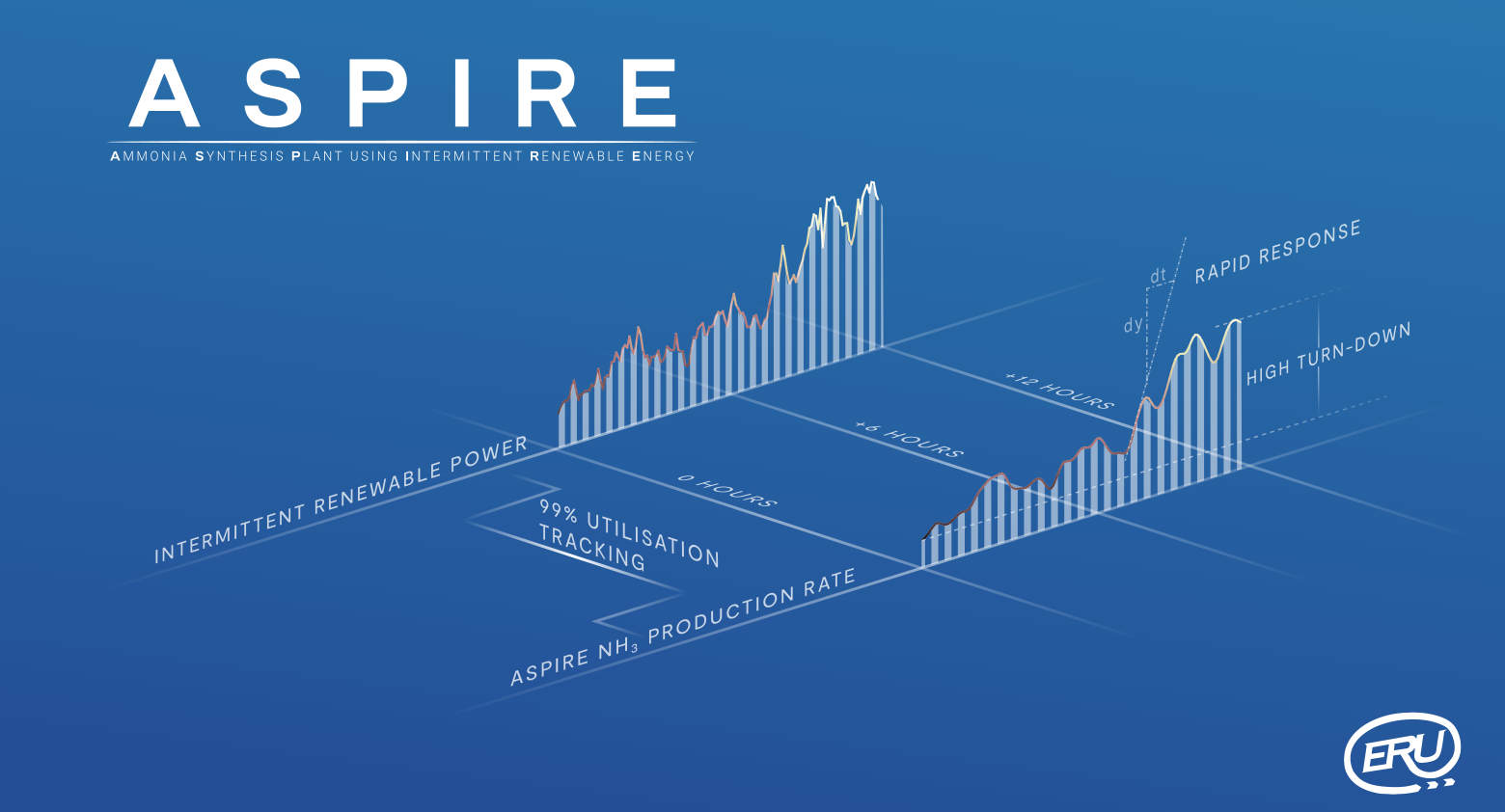
ASPIRE is a first-of-a-kind green ammonia demonstration plant designed to generate ammonia using only water, air and renewable electricity as the inputs. The fundamental aim of the project is to demonstrate that the cost of green ammonia can be bought down to a level where it becomes a realistic alternative for grey ammonia which is responsible for 2% of global greenhouse emissions. The ASPIRE plant achieves this by having a flexible ammonia generation process, a control system that can match plant load to an intermittent supply, and a power handling system that facilitates micro grid operation with maximum utilisation of available renewables.
Aspire Timeline
- Phase One - Feasibility Study start January 2022
- Phase One - Feasibility Study end September 2022
- Phase Two - Demonstration start March 2023
- Phase Two - Demonstration end Ongoing
ASPIRE (Ammonia Synthesis Plant using Intermittent Renewable Energy)
- Project ASPIRE is a world leading innovative demonstration of the flexible generation of ammonia funded by a £4.28M contract from the UK Department for Energy Security and Net Zero (DESNZ).
- The project, which aims to demonstrate that flexible green ammonia plants can be technically and economically feasible, is nearly complete. It is now entering its commissioning phase, and due to become operational in autumn 2025.
- ASPIRE brings a number of technical advantages over traditional ammonia production, including lower carbon emissions than both grey (<10% of grey) and blue production (<30% of blue); scalability; and ability to operate directly from renewable power.
- Commercial advantages include the ability to make use of cheap electricity, avoid emissions penalties, and that it is unaffected by volatile gas prices.
- There is very high climate mitigation impact potential to be realised by demonstrating cost effective flexible green ammonia production. Potential new uses of green ammonia, such as a carbon-free fuel in shipping, could unlock global CO2 savings of 10-15%.
What is green ammonia and how do green ammonia plants work?
Green ammonia is a term used for ammonia made with hydrogen derived from electrolysis of water powered by renewable energy. However, production of green chemicals, such as green ammonia, will require a new generation of plants, designed to flex depending on the availability and cost of renewable power. This flexibility allows the plant to be powered by green electrons either from a microgrid or from the National Grid via a renewable power-purchase agreement - in both cases available power is fluctuating and so the ability to ramp the generation rate up and down accordingly is key to reaping the maximum potential carbon benefits. The project aims to demonstrate that flexible green ammonia plants can be technically and economically feasible.
Advantages over current ammonia production method
Current ammonia production, known as grey ammonia is produced in large-scale, steady-state Haber-Bosch plants where hydrogen is obtained from natural gas through Steam-Methane-Reforming. Grey ammonia production is responsible for 2% of global CO2 emissions. Traditionally running using plentiful natural gas supplies these plants are optimised for steady-state operation; their catalysts and thermal management are designed to achieve maximum efficiency at a large scale in a narrow range of operation. In Puertollano (in Spain), such a plant has been fed with hydrogen from a 20MW solar powered electrolyser so that, when possible, a portion of the input hydrogen is green and otherwise obtained from natural gas. However commercial plants like this can only be viably turned down to 70 or 80% of their maximum output. Other industrial innovations developed elsewhere include implementing carbon capture and storage with the grey process (blue production). ASPIRE brings the technical advantages of having much lower carbon emissions than both grey (<10% of grey) and blue production (<30% of blue), being scalable, and being able to operate directly from renewable power. Its commercial advantages are that it can make use of cheap electricity, avoid emissions penalties, and its cost is decoupled from the volatile price of natural gas.
Current Status of Project ASPIRE
Project ASPIRE is currently the UK’s flagship green ammonia project. The construction of the ASPIRE plant at the STFC Rutherford Appleton Laboratory in Oxfordshire is nearly complete, just entering its commissioning phase, and due to become operational in autumn 2025. Several innovations around the design will be demonstrated which include a high turn-down rapid response synthesis reactor, low pressure drop synthesis loop, and a control system to minimise expensive battery or hydrogen storage requirements and to maximise utilisation of an intermittent power supply.
Potential Impact
There is very high climate mitigation impact potential to be realised by demonstrating cost effective flexible green ammonia production. This project could trigger the development of decentralised dedicated green ammonia plants enabling countries to generate their own ammonia from local renewable power supplies rather than importing it. This could mean current production of grey ammonia used for fertiliser could transit to green ammonia saving towards 2% of global CO2 emissions. In addition, green ammonia production is predicted to expand significantly over the next 10-20 years as it is adopted as a carbon free fuel in hard-to-decarbonise sectors such as shipping, peaking power plants and in the supply of hydrogen fuelling stations. These new uses could unlock global CO2 savings of 10-15%. The benefit of generating green ammonia locally is that ammonia price will not be affected by volatile gas prices, thus bringing energy security as well as food security. Other green chemicals, such as carbon neutral hydrocarbons, will also have to be generated from green electrons and the ASPIRE project is attracting attention from developers of sustainable aviation fuel production plants.
Achieving Net Zero requires a solution for using renewable energy that is currently “curtailed”. In 2024 the annual cost to UK taxpayer of paying to shut down wind farms exceeded £1billion for the first time. The National Grid future energy scenarios for achieving Net Zero rely heavily on hydrogen as an energy vector. However, due to the high cost of storing compressed hydrogen or liquid hydrogen, we suggest that ammonia will definitely be part of the picture.
Project Leads

Dr Tristan Davenne
Project Contact


Dr Jim Hallliday
Project Sponsor
Engineering Team

Benjamin Peters
Senior Mechanical Engineer

Adam Huddart
Senior Mechanical Engineer

Dominique Tallentire
Mechanical Engineer
Claire Robertson
Mechanical Engineer

Jayke Smith
Graduate Mechanical Engineer
Movin Jayasinha
Mechanical Engineer
Electrical Team
Joe Tynan
Electrical Engineer
Mike Lowe
Principal Electrical Engineer
Paul Dickenson
Senior Electrical Engineer
Project Management
Mark Thomas
Project Manager
Callum Taylor
Project Manager
Partners


Steering Commitee
Funding Body