
Assessment of Wind Energy Utilisation Potential in Moderately Windy Built-up Areas
Funded by European Commission [JOR3-CT98-0270]
September 1998 to August 2000
Project Objectives
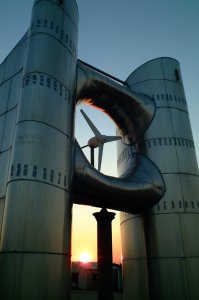 To assess typical wind
regimes around European built-up areas using existing statistical data.
To assess typical wind
regimes around European built-up areas using existing statistical data.- To develop wind enhancement and integration techniques for low to moderate wind speed areas (2 to 5 m/s annual average) to increase the ‘qualifying land mass area’ for potential wind utilisation in the EU by improving the annual energy yield per installation for a given site and wind regime. Wind regimes identified in item 1 above form the basis for this study. Particular attention given to wind concentration techniques using optimised building forms and purpose-made solid structures to create an ‘accelerated wind environment’. This study involved tests using Computational Fluid Dynamics (CFD) modelling.
- To prove/demonstrate the above techniques on a small-scale model in a wind tunnel. To optimise the concentrator design. To assess comparative performance of different concentration options.
- To develop testing and design specifications for two turbine/concentrator design prototypes to cater for the above applications. In particular, the team looked into configurations with respect to noise emissions, which are suitable for sensitive environmental integration in or around inhabited (industrial or residential) areas.
- To test two turbines with concentrators in a moderately windy area, according to the specification developed in 4 above. Measurement parameters included site meteorological data, power output, noise emissions and vibration.
- To analyse results and draw conclusions applicable to a range of turbine applications and wind conditions in Europe.
- To assess and improve prospects for social, aesthetical, architectural and urban planning acceptability of such wind energy applications by raising public awareness, defining performance and technical guidelines.
Project Work at RAL
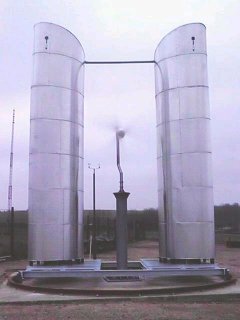 Two nominally 2 m diameter turbines were used in the field testing: a
Horizontal Axis Wind Turbine (HAWT) and a Vertical Axis Wind Turbine (VAWT). The Partners designed a
concentrator or Full Scale Model (FSM) in conjunction with the field testing laboratory (RAL). Both turbine
types were tested in stand alone and then within the basic two towered concentrator. The HAWT was tested
further when infills were installed between the original towers. Field tests included measurements of the
meteorological data and system parameters including power. Imperial College (assisted by RAL) also measured
the noise and vibration associated with the different configurations.
Two nominally 2 m diameter turbines were used in the field testing: a
Horizontal Axis Wind Turbine (HAWT) and a Vertical Axis Wind Turbine (VAWT). The Partners designed a
concentrator or Full Scale Model (FSM) in conjunction with the field testing laboratory (RAL). Both turbine
types were tested in stand alone and then within the basic two towered concentrator. The HAWT was tested
further when infills were installed between the original towers. Field tests included measurements of the
meteorological data and system parameters including power. Imperial College (assisted by RAL) also measured
the noise and vibration associated with the different configurations.
Project Partners (Number, Name, Contact & Key Global Functions of the Partner)
-
BDSP Partnership - Sinisa Stankovic
Energy and renewable integration specialist; co-ordination and research into wind regimes in built-up areas - University of Stuttgart - Institute for Building Construction and Design(UST) - Jörg Hieber
Handles architectural, aesthetical and urban integration issues; planning issues; social acceptance testing - MECAL - Marcel van
Duijvendijk
Structural issues, resonance, stability, noise, vibration - Imperial College London - Department of Aeronautics (ICSTM) - Prof Mike Graham
Wind issues, wind tunnel testing, turbine and concentrator aerodynamics
http://www3.imperial.ac.uk/aeronautics - RAL (Sub-contractor to ICSTM) - Jim
Halliday
Wind turbine testing laboratory, performing field tests on two turbine/concentrator configurations
https://www.eru.rl.ac.uk/
The wind turbines used in testing
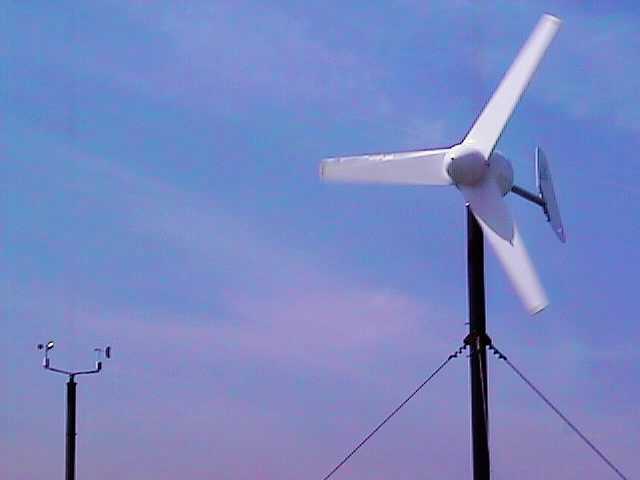
| 1. | The 3 bladed Marlec FM1803 HAWT The 1.869 m diameter Marlec FM1803 (24V version) HAWT was used in the testing. Its blades rotate clockwise when viewed from up wind. It was different from the standard two bladed version Marlec FM1803 in that it was fitted with three blades at the WEB Consortium’s request. Given the production model control unit, this has the effect of the rotor turning faster for a given wind speed (as the load is the same) when its optimum performance is actually achieved if the rotor turns slower. Hence any absolute data presented should not be taken as representing good performance of a turbine this size. |
 |
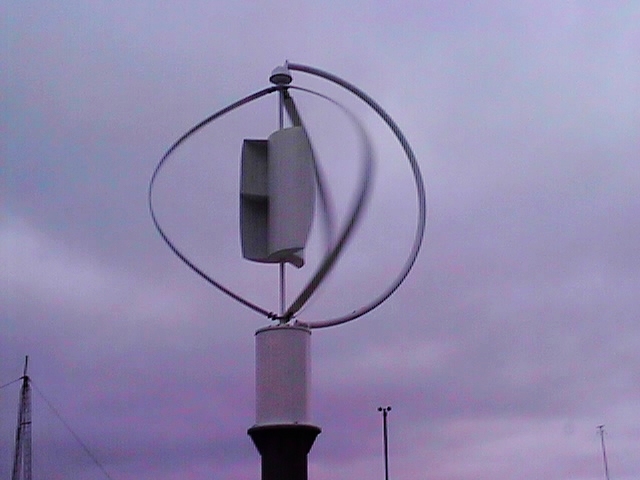
| 2. | The DIC Globuan VAWT The Globuan has a 2 m diameter rotor consisting of a three bladed troposkein Darrieus (egg beater) with a Savonius rotor in its centre. The Darrieus develops most of the power whereas the Savonius enables self-starting as well as regulating the maximum rotor speed by adding drag at high wind speeds. Its blades rotate clockwise when viewed from beneath. DIC incorporated a Marlec 1 kW 120 V AC ironless generator, the same as used in the Marlec FM1803, which enabled the same battery regulator and data acquisition system to be used as for the FM1803. |
 |
Test Results
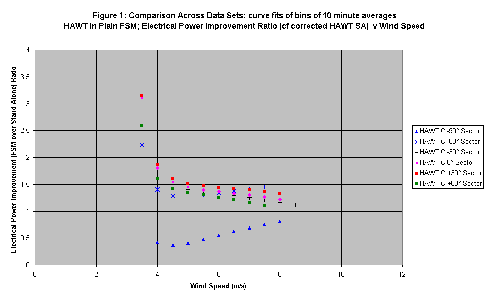
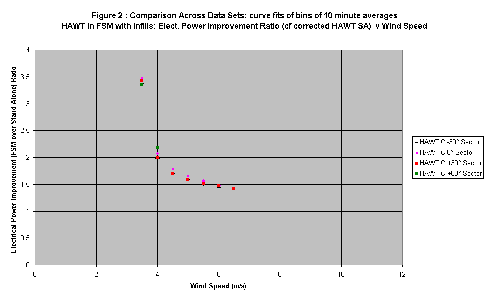
RAL has fully reported the test results to Imperial College in a report entitled 'Field Testing of Two Wind Turbines in and out of the WEB Full Scale Model (FSM)', September 2000, by Mike Blanch. The figures below show the improvement in HAWT performance over that in stand alone when it was running in the plain concentrator or FSM (Figure 1) and the concentrator or FSM with infills (Figure 2).
Field Testing Conclusions
Both the HAWT and the VAWT turbines show enhanced performance within the FSM for an incident wind (or concentrator yaw) angle range of ±60°. Power generation generally starts in wind speeds at least 1 m/s below the cut-in wind speed of the stand-alone turbine. This will considerably enhance energy collection in low wind speed sites (typical of urban areas). At the wind speed of 8 m/s the HAWT’s performance is enhanced from 155 W to 190 W (from a Ce of 1.8 to 2.8) and the VAWT’s performance is enhanced from 40 W to 90 W (from a Ce of 0.33 to 1.1). The electrical power output of both turbines is improved by a large ratio at low wind speeds and a lower ratio at high wind speeds. The performance of the VAWT is enhanced by a factor of more than 2 at 8 m/s, while the HAWT is improved by a factor of between 1.2 and 1.3 (depending on incident wind angle) at the same speed. However the greater enhancement of electrical power, which does take into account energy conversion losses, measured for the VAWT in no way suggests that it is more suited to FSM. After accounting for the VAWT’s 15% larger swept area, the HAWT in the FSM produces 2.4 times as much power as the VAWT in the FSM at 8 m/s. The infills further enhance the performance of the HAWT in the concentrator when operating in low wind speeds, but the enhancement appears to become negligible above 6 m/s.
Wind Energy for the Built Environment Workshop
This was held at RAL on 11th September 2001 at STFC RAL
- Programme (PDF: 230 KB, 1 page)